

WHAT HAPPENED TO NVIDIA STOCK
NVIDIA has just pushed back against the whole “AI bubble” narrative with one of the strongest quarters seen from a global blue chip in recent memory. Even so, the share price pulled back after the results were announced.



What NVIDIA announced
NVIDIA released its results for the fourth quarter of fiscal 2025 on 26 February 2026, delivering record numbers that comfortably exceeded market expectations. Revenue came in well above consensus forecasts, and earnings per share were also strong. In addition, management’s guidance for the next fiscal quarter pointed to revenue meaningfully higher than analysts had anticipated. Despite these clear beats, the stock fell following the announcement.
Reaction of NVDA shares
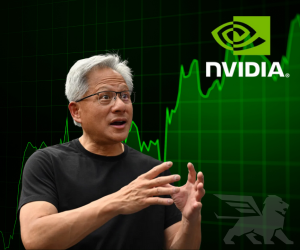
Although both the results and the forward guidance were solid, NVIDIA shares dropped by more than 5% on the day of the release and closed well below the opening price. The decline came even after an initial lift immediately after the announcement.
The fall in NVDA was significant enough to weigh on major technology indices, which finished the session in negative territory. This indicates the reaction wasn’t isolated to one company but reflected broader sentiment across the tech sector.
Why the stock fell despite strong results
A number of technical and market-related factors help explain why the share price eased despite record performance:
- Very high expectations: much of the positive surprise had likely already been priced in ahead of the release, limiting further upside once the figures were confirmed.
- “Sell-the-news” behaviour: traders who bought in before earnings may have taken the opportunity to lock in gains, adding short-term selling pressure.
- Concerns about sustainability of demand: some investors remain cautious about whether current levels of AI infrastructure spending can be sustained over the longer term.
- Elevated valuations: NVDA and the wider tech sector were trading on demanding multiples, which may have triggered additional selling around key price levels.
Taken together, these factors contributed to a more measured market response than the headline numbers alone might suggest, resulting in a notable post-earnings correction.

NVIDIA in the semiconductor industry today
NVIDIA now holds a central role in the global semiconductor industry, not because it runs its own fabrication plants, but because it designs some of the most sought-after processors for accelerated computing. Its value proposition rests on high-performance architectures (primarily GPUs and AI accelerators), a fabless model that relies on leading foundries such as TSMC (Taiwan Semiconductor Manufacturing Co.), and, importantly, a well-developed software ecosystem that makes its hardware more powerful and harder to replace.
Within the semiconductor value chain, NVIDIA sits in one of the most differentiated segments: advanced chip design and full platform integration (hardware, libraries and development tools). This positioning allows the company to capture strong margins, iterate quickly on new architectures and respond to technology cycles where demand is increasingly centred on AI model training and inference workloads.
From GPUs to AI and data centre infrastructure
For years, NVIDIA was largely associated with graphics and gaming, and later with cryptocurrency mining. The major strategic shift came when GPUs proved ideal for massive parallel processing – a core requirement for modern artificial intelligence and high-performance computing. Since then, the data centre segment has become the primary driver of its growth and relevance: the “chip” is no longer a standalone product but part of a broader accelerated computing infrastructure.
In practical terms, NVIDIA sits at the heart of systems that train large-scale models, process significant volumes of data and run compute-intensive workloads. This makes it a strategic supplier not only to global technology firms, but also to industries such as finance, healthcare, energy, automotive and scientific research, where AI capabilities are increasingly embedded into everyday operations.
The platform advantage: hardware, software and tools
A key differentiator is that NVIDIA competes as a platform, not just as a chip provider. CUDA and its suite of optimised libraries and frameworks (covering deep learning, computer vision, simulation and data science) act as a productivity layer. They reduce friction for developers, speed up time-to-market and encourage standardisation of technology stacks around NVIDIA hardware.
This creates a degree of technical stickiness: the more software that is built and tuned for NVIDIA, the more costly – in both time and performance – it becomes to switch to alternative solutions. In a semiconductor industry where performance is fiercely contested, software can be as important as the silicon itself.
Strategic positioning in the global value chain
As a fabless company, NVIDIA focuses its resources on research and development, architecture and design, while relying on top-tier manufacturers for production. In a market where advanced process nodes and packaging technologies can become bottlenecks, this model combines innovation with access to cutting-edge manufacturing capability.
At the same time, the company is expanding beyond GPUs into high-speed networking for data centres, interconnect technologies and integrated system-level solutions designed to optimise the full stack – not just the chip. The direction of the industry suggests that real-world performance increasingly depends on how compute, memory, networking and software work together.
Direct and indirect competitors
In semiconductors, competition can take many forms: competing directly in GPUs and AI accelerators, offering alternative cloud-based solutions, or replacing parts of the broader compute stack (CPU, memory or networking) that shape overall performance. It’s useful to distinguish between direct and indirect competitors.
Direct competitors
- AMD: competes in GPUs and data centre accelerators, often highlighting performance per dollar and a competing software ecosystem.
- Intel: offers GPUs and AI accelerators alongside integrated data centre platforms.
- Google: develops proprietary AI accelerators tailored to workloads within its cloud environment.
- Amazon Web Services: provides in-house AI chips optimised for training and inference in its cloud infrastructure.
- Microsoft (and other hyperscalers): invest in proprietary accelerators and AI stacks to reduce reliance on third-party suppliers.
More indirect competitors
- Apple: competes indirectly through integrated GPUs and machine learning engines in its own system-on-chip designs.
- Qualcomm: focuses on efficient computing and AI acceleration in mobile and edge devices, where power efficiency is critical.
- Arm: supplies widely used CPU architectures that underpin alternative platform designs.
- Broadcom: dominates key networking components for data centres, influencing overall system performance.
- FPGA and specialised accelerator providers: operate in niches where reconfigurable or dedicated acceleration may offer advantages for specific workloads.
- Memory manufacturers (such as DRAM and HBM suppliers): don’t replace NVIDIA directly, but materially influence cost structures and supply dynamics in AI systems.
- Companies building in-house chips: compete by developing proprietary hardware to reduce costs, secure supply and control more of the technology stack.
Outlook for NVIDIA
In this final section, we look at the broader implications: how the quarter reshapes the AI capital expenditure narrative, which price levels and scenarios market participants are likely to watch, and how different investor profiles might frame risk from here – while noting that this is not personalised financial advice.
The updated AI supercycle story
Before this quarter, it was still possible to argue that the AI infrastructure boom was strong but potentially fragile – reliant on hyperscaler budgets, export policy settings and ongoing corporate capex discipline. After these results, that case looks less convincing. Hyperscalers are not only maintaining spending but accelerating into 2026. Blackwell systems are largely spoken for, and large-scale AI projects continue to expand. This looks more like the middle of an investment cycle than the end of one.
Crucially, NVIDIA’s internal economics continue to scale effectively with demand. Gross margins remain in the mid-70% range, operating expenses are growing more slowly than revenue, and the company is layering systems, software and full-stack solutions on top of its silicon. Each additional dollar in data centre revenue is therefore both significant and highly profitable.
A pragmatic playbook
With the latest information in hand, how might different types of investors approach NVIDIA?
Long-term fundamental investors: may see recent quarters as confirmation that the AI infrastructure cycle could extend through 2026–2027 at elevated levels. The focus is likely to remain on volumes, backlog, supply constraints and software penetration rather than day-to-day price movements.
Sector and macro allocators: need to recognise that NVIDIA has effectively reset expectations across the AI complex. At the same time, concentration risk in a single multi-trillion-dollar company calls for disciplined position sizing.
Options traders: should be mindful of the volatility environment, as each earnings release increasingly resembles a macro-level event.
Retail investors buying the dip: the latest quarter may have strengthened the long-term thesis more than it validated short-term timing. Diversification and appropriate exposure remain important considerations.
Risks still in play
Export controls could tighten, competing architectures may gain incremental share, and infrastructure constraints – such as power supply and cooling capacity – could slow deployment timelines. Given NVIDIA’s scale, even a modest deceleration relative to optimistic forecasts could trigger heightened volatility.
Strong results do not remove risk; if anything, elevated expectations make disciplined risk management more important. NVIDIA remains at the centre of the AI investment story, supported by powerful fundamentals but also by high market expectations.